


*This blog post has since been removed from GovLoop, so I’m sharing the original blog post below.
Upon watching Star Wars’ ‘Acolyte’ I noticed how disjointed and chaotic the High Republic operated a long time ago in a galaxy far far away. Enjoy these organizational management lessons the force awakened in me by watching this series.
____________________________________________________________________________________________________
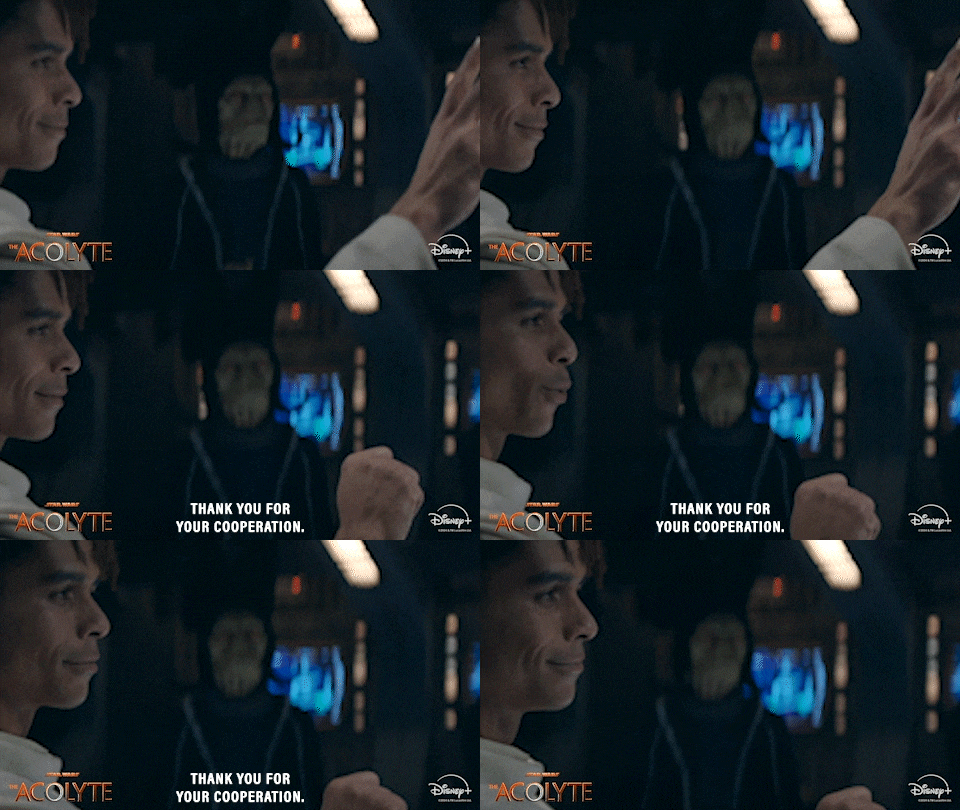
A long time ago in a galaxy far far away, a new Star Wars series, “The Acolyte” portrays the late years of the High Republic. And as with any governmental body or organization, the management of such an entity encounters challenges in effective leadership. Disney+’s “The Acolyte” is no exception with plenty of lessons learned throughout the series. Here are four organizational management lessons I learned from watching that can help organizations avoid common operational pitfalls.
Spoiler alert: This blog post contains various plot details for “The Acolyte”. Turn back if you have a bad feeling about this.
Effective Decision-Making
According to Gallup, one in four (24%) managers strongly agree their peers make well-thought-out decisions. The study also shares how decisions should be made using a holistic view starting with the “Foundation” dimension.
In “The Acolyte” the “Foundation” pillar was overlooked as Jedi Master, Vernestra Rwoh, failed to stick to the original mission of the plot, which was to find and apprehend the assailant that was eliminating Jedis. Instead, the original purpose of the mission continued to shift as she was persuaded by her counterpart, Jedi Sol. As a result, certain required protocols weren’t followed and reports to chain of command weren’t made. This created an unstable situation which caused further casualties and lack of awareness. Effective decision-making best practices were not enforced nor transparent.
Transparency
A symptom of poor decision-making in “The Acolyte” is a lack of transparency. A study conducted by Slack shares that over 80% of workers want a better understanding of how decisions are made with half of employees surveyed in the Edelman Trust Barometer stating they don’t trust their boss.
As the season progresses in “The Acolyte” a lack of transparency leads down a path where Jedi Masters Vernestra and Sol withhold information from the Jedi High Council on of the status of their mission. This creates a lack of accountability and eventual investigations by the Galactic Senate into the operations of the Jedi Order. Providing transparency about the prime cause of the Jedi casualties also stemmed from Jedi Sol not sharing complete information after a mission gone wrong 16 years prior. This, over time, resulted in the current threat to the Jedi Order during the series.
After Action Reviews
The lack of transparency with the Jedi High Order and Galactic Senate could have been avoided if Jedi Sol and his team wrote an honest, good ‘ol fashion, After Action Review following their failed mission to Brendok, 16 years prior. According to Harvard Business Review, After Action Reviews were developed by the U.S. Army in the 1970s to chronicle failed operations and how to make sure future failures don’t happen again. In the early 2000s they became a common tool with outside organizations.
Probably the most crucial recommendation the Harvard Business Review study implores organizations to commit with After Action Reports is to “tell the whole story”. In “The Acolyte” it was this lack of full storytelling that hid the true events of the failed mission on Brendok where the two young “Force-sensitive” twins, Osha and Mae, were separated without either knowing the fate of the other for sixteen years. It was also the Jedi High Council’s failure of not requiring a thorough account of the events that took place. They simply took the Jedi team’s word and moved on. Do or do not complete an After Action Report. There is no try.
Team Appreciation
One final organizational management lesson learned from “The Acolyte” is the importance of appreciating the small contributions from other team members. Based on another study by Harvard Business Review, recognizing employee’s contributions is key to not letting them feel isolated from the larger organization or other team members.
Intended for comic relief, two characters in “The Acolyte” that routinely provide support to advance the investigation of Mae’s crimes are Pip, a droid, and Bazil, a tracker (who basically appears as an adorable otter with posable thumbs and stumpy legs). However, no genuine appreciation is given to them despite their honorable contributions. I find their lack of appreciation for them disturbing.
May the Force be with you in applying these organizational management concepts to your day-to-day operations. The full season of “The Acolyte” is now streaming on Disney+.